Herb Thyme Purple Creeping Seeds
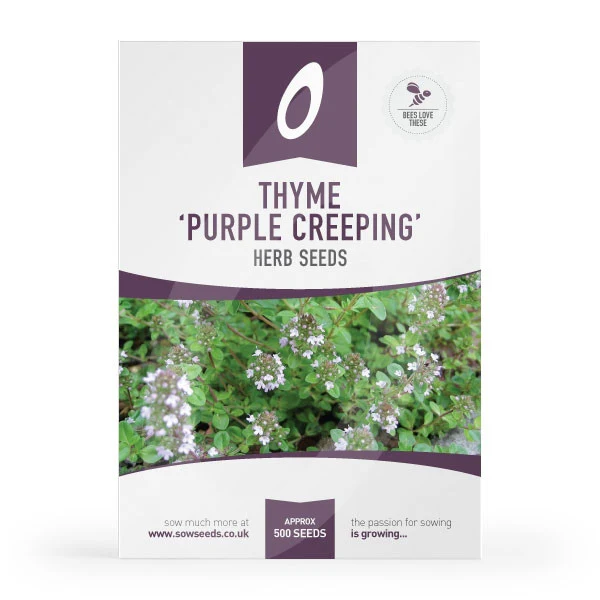
Purple Creeping Thyme is a hardy evergreen perennial and has small aromatic dark green leaves with clusters of small pale pink flowers.
Purple Creeping Thyme can be picked all year round, once established, and is the classic herb used in Bouquet Garni (see recipe on Parsley page). Also great for stuffings, chicken dishes and stews.
It is a low growing, matt forming type and only reaches a height of 10cm & but has a spread of up to 1m. Purple creeping thyme is not as easy to pick as English Winter Thyme can still be used in the same recipes. The flavour is at it's best from June to July and it does well with freezing & drying or infusing in oil.
Purple Creeping Thyme is a great companion plant and deters cabbage root-fly from cabbages, cauliflowers and brussels sprouts but the flowers also attract many beneficial insects to the garden.
Thyme is a great addition to the garden and can be used to make thyme paths, as a ground cover plant or planted in rockeries or dry-stone walls.
Thyme Purple Creeping Herb Seed Information
| Seed Quantity: | Approx 500 seeds per pack. |
| Site: |
Sunny, well drained incorporate grit if tendency to be wet.
|
| When to Sow |
March to May or August to September.
|
| How to Sow: |
The seed is very fine so mix some with horticultural sand to make it easier to handle. Sprinkle seed thinly on seed trays but cover the seed very very lightly or not at all. Place ideally in a heated propagator or cover with a polythene bag and keep at 20C. Seed should germinate in 2 weeks. Transplant into small pots when large enough. (Thyme can be multi-sown on to a plug tray to avoid the pricking out stage). When thyme plants are about 5cm tall, 'harden off' for 3-4 days & transplant to garden or container when risk of frost has passed. Plant herbs 30cm apart and add grit to planting hole if soil is not light.
|
| Care: |
Be careful to keep watering to a minimum as seedlings are prone to damping off and always water from the bottom. Thyme is a woody perennial so after 3 years it will need dividing to encourage fresh vigour and after 5 years it will probably need replacing, but cuttings are easy to take.
|
| Harvest: | It can be picked very lightly in it's first year but if possible leave alone in first year and pick from second year. It can be harvested all year round but only lightly in winter as it isn't growing. Once established can be picked all year. |
When to Sow Thyme Purple Creeping Herb Seeds
| Jan | Feb | Mar | Apr | May | Jun | Jul | Aug | Sep | Oct | Nov | Dec |
|---|---|---|---|---|---|---|---|---|---|---|---|
 |
|
 |
|
|
|
|
|
|
|
|
|
Product Information
Product Information
Shipping & Returns
Shipping & Returns


Herb Thyme Purple Creeping Seeds
Herb Thyme Purple Creeping Seeds
Purple Creeping Thyme is a hardy evergreen perennial and has small aromatic dark green leaves with clusters of small pale pink flowers.
Purple Creeping Thyme can be picked all year round, once established, and is the classic herb used in Bouquet Garni (see recipe on Parsley page). Also great for stuffings, chicken dishes and stews.
It is a low growing, matt forming type and only reaches a height of 10cm & but has a spread of up to 1m. Purple creeping thyme is not as easy to pick as English Winter Thyme can still be used in the same recipes. The flavour is at it's best from June to July and it does well with freezing & drying or infusing in oil.
Purple Creeping Thyme is a great companion plant and deters cabbage root-fly from cabbages, cauliflowers and brussels sprouts but the flowers also attract many beneficial insects to the garden.
Thyme is a great addition to the garden and can be used to make thyme paths, as a ground cover plant or planted in rockeries or dry-stone walls.
Thyme Purple Creeping Herb Seed Information
| Seed Quantity: | Approx 500 seeds per pack. |
| Site: |
Sunny, well drained incorporate grit if tendency to be wet.
|
| When to Sow |
March to May or August to September.
|
| How to Sow: |
The seed is very fine so mix some with horticultural sand to make it easier to handle. Sprinkle seed thinly on seed trays but cover the seed very very lightly or not at all. Place ideally in a heated propagator or cover with a polythene bag and keep at 20C. Seed should germinate in 2 weeks. Transplant into small pots when large enough. (Thyme can be multi-sown on to a plug tray to avoid the pricking out stage). When thyme plants are about 5cm tall, 'harden off' for 3-4 days & transplant to garden or container when risk of frost has passed. Plant herbs 30cm apart and add grit to planting hole if soil is not light.
|
| Care: |
Be careful to keep watering to a minimum as seedlings are prone to damping off and always water from the bottom. Thyme is a woody perennial so after 3 years it will need dividing to encourage fresh vigour and after 5 years it will probably need replacing, but cuttings are easy to take.
|
| Harvest: | It can be picked very lightly in it's first year but if possible leave alone in first year and pick from second year. It can be harvested all year round but only lightly in winter as it isn't growing. Once established can be picked all year. |
When to Sow Thyme Purple Creeping Herb Seeds
| Jan | Feb | Mar | Apr | May | Jun | Jul | Aug | Sep | Oct | Nov | Dec |
|---|---|---|---|---|---|---|---|---|---|---|---|
|
|
|
|
|
|
|
|
|
|
|
|
Product Information
Product Information
Shipping & Returns
Shipping & Returns
Description
Purple Creeping Thyme is a hardy evergreen perennial and has small aromatic dark green leaves with clusters of small pale pink flowers.
Purple Creeping Thyme can be picked all year round, once established, and is the classic herb used in Bouquet Garni (see recipe on Parsley page). Also great for stuffings, chicken dishes and stews.
It is a low growing, matt forming type and only reaches a height of 10cm & but has a spread of up to 1m. Purple creeping thyme is not as easy to pick as English Winter Thyme can still be used in the same recipes. The flavour is at it's best from June to July and it does well with freezing & drying or infusing in oil.
Purple Creeping Thyme is a great companion plant and deters cabbage root-fly from cabbages, cauliflowers and brussels sprouts but the flowers also attract many beneficial insects to the garden.
Thyme is a great addition to the garden and can be used to make thyme paths, as a ground cover plant or planted in rockeries or dry-stone walls.
Thyme Purple Creeping Herb Seed Information
| Seed Quantity: | Approx 500 seeds per pack. |
| Site: |
Sunny, well drained incorporate grit if tendency to be wet.
|
| When to Sow |
March to May or August to September.
|
| How to Sow: |
The seed is very fine so mix some with horticultural sand to make it easier to handle. Sprinkle seed thinly on seed trays but cover the seed very very lightly or not at all. Place ideally in a heated propagator or cover with a polythene bag and keep at 20C. Seed should germinate in 2 weeks. Transplant into small pots when large enough. (Thyme can be multi-sown on to a plug tray to avoid the pricking out stage). When thyme plants are about 5cm tall, 'harden off' for 3-4 days & transplant to garden or container when risk of frost has passed. Plant herbs 30cm apart and add grit to planting hole if soil is not light.
|
| Care: |
Be careful to keep watering to a minimum as seedlings are prone to damping off and always water from the bottom. Thyme is a woody perennial so after 3 years it will need dividing to encourage fresh vigour and after 5 years it will probably need replacing, but cuttings are easy to take.
|
| Harvest: | It can be picked very lightly in it's first year but if possible leave alone in first year and pick from second year. It can be harvested all year round but only lightly in winter as it isn't growing. Once established can be picked all year. |
When to Sow Thyme Purple Creeping Herb Seeds
| Jan | Feb | Mar | Apr | May | Jun | Jul | Aug | Sep | Oct | Nov | Dec |
|---|---|---|---|---|---|---|---|---|---|---|---|
|
|
|
|
|
|
|
|
|
|
|
|